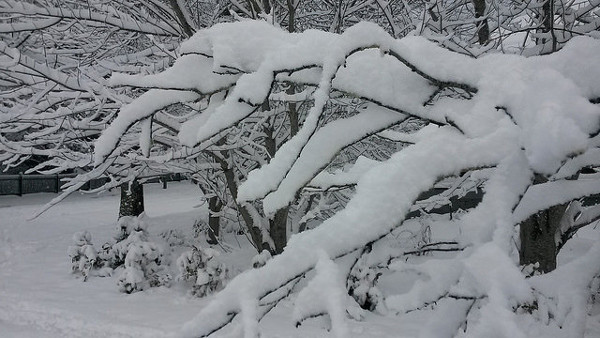
Winter Cold Outbreak News

Notes on Developing Cold Fronts


Percentage Forecasting:

This percentage system below will now be used for snow shower forecasting. Settled snow is generally too hard to predict for the upper mountains.

5% to 10% chance = unlikely to see much snow.
10% to 20% chance = very slight chance of snow.
20% to 30% chance = slight chance of snow.
30% to 40% chance = slight to moderate chance of snow.
40% to 50% chance = moderate chance of snow.
50% to 60% chance = moderate to good chance of snow.
60% to 70% chance = get out the skis.
70% to 80% chance = get out the snow plow.
80% to 100% chance = I'm lying and drinking too much green cordial.

Winter 2010 notes:

Saturday, 4pm: July 31st, 2010:

There is at least a 50% to 60% chance of snow for the Oberon Plateau above 1100M on Sunday afternoon and into Monday morning, possibly lowering to 1000M. The upper Blue Mountains (above 1000M) is about a 30% chance of seeing snow overnight Sunday at this stage and into Monday. Its not an amazing system but its easily the best system on paper this winter.

By the looks of the MLAPS forecasting model, the best time to see snow here in the upper Blue Mountains would be late Sunday evening and into early Monday. Some seriously cold temps at 500hPa are around at this time but we need mid level moisture and 850hPa temps to come to the party for any decent snow. I'm guessing the BoM will include at least sleet in the BM forecast this arvo, for late Sunday or into Monday. Blackheath should see a min of around 1C with possible showers for Monday.

I wish the progged surface low was in a better position but lets see how it all looks tomorrow in real-time. Stay tuned for more updates on what is the best system for this winter, for sure.

NB: The upper cold pool type systems that have been around so far this year (and in recent years) create problems for the models as their path is hard to predict. Very basically, upper cold pools are blobs of colder than average air about 5000 metres above the surface that vary a lot in size and direction. They move up from the Southern Ocean and underneath them is where snow can form, if they are cold enough and there is enough moisture and instability associated with them.

Of course, the lower levels of the atmosphere have to be cold enough too, for the precipitation to survive as snow. That's where the weather balloon soundings that are sent up each day really help forecasters, as you can look at all of the details of the atmosphere and see what a cold air mass is actually like. Wouldn't it be great to just get a classic cold outbreak for once that is fairly predictable! It would make it much easier for snow forecasters. ;)

The snow depths down in the ski fields have improved notably, although they really need some follow up snowfalls to consolidate the base. Still, snowmaking should really help things now with the cold nights.

Winter 2010 Snow Cams - An Accurate Indication of Snow Depths

The Charlotte Pass Cam being so high and free of snow making away from the centre of the photo, shows just how snowless this season is at present, even at these higher levels.

The Rock Creek Area Cam also gives an accurate representation of conditions away from the snow making. The elevations in the view are from 1760m in the valley to 1860m on the peaks in the distance. During typical winters this view would be covered with between 1m and 2m average snow depth. In 2008 the valley was covered quite well with around 130cm for nearly 2 months. An ordinary year would show at least a metre cover here and two to three metres in a great year, at least. This information comes to me from someone who has skied in this area often.

The Smiggin Holes Cam is also a good guide for true conditions away from the man-made cover in the foreground.

Stop press: The Catalyst program on ABC TV recently was excellent. A very unusual event has been occuring in Antarctica that seems to be connected to human induced climate change. Ice core records are showing some very fascinating changes to our climate in the last thirty years that are almost unheard of for possibly the last 20,000 to 30,000 years. See here for more info. Click on the Series 11 link once you get to that site. Of course, this work is relatively new so whilst it looks like human induced climate change is the cause here, it may not be - even the researchers admit that. Its a bit of a worry for we cold climate lovers though. We live in interesting times, to say the least.

Just a quick note: The colder Northern Hemisphere winter (in certain parts) and the Iceland volcano are unlikely to bring us a colder winter here in the Southern Hemisphere. I'm not saying this winter wont be cold (who knows?) but its not related to NH happenings, in this context. Certain parts of the NH were colder than average last winter but certainly not all of them and a cold winter up north is not connected to a cold winter in the SH. And see here for more info on the Iceland Volcano.

There is also a common thought that Lake Eyre filling means a better winter to follow with stronger cold fronts but this doesn't seem to be the case either. I used to somewhat believe this myself as a younger fella, after living in farming areas further south. See here

NB: The forecasts and outlooks above are informal considerations presented by blackheathweather.com. Please refer to the main page for official BoM forecasts.

--------
Debunk The Myth

I often hear it said in Blackheath that we didn't get snow because it was too windy. There is no scientific basis to this at all. Its just that most cold fronts come from a SW direction and are usually windy and bring more snow to the Oberon Plateau than they do to the Blue Mountains. Its not because its too windy that we don't get snow its because we are downwind of the Oberon Plateau and during most cold fronts they 'steal' most of our snow. Without wind, the cold air from down south wouldn't get here in the first place. So snow lovers, tell your mates that its not the wind that prevents the Blue Mountains from getting snow at all, its the Oberon Plateau in most situations.

NB: We still can get nice snowfalls from the SW but you need cold upper levels (at least minus 27C at 500hPa) and good mid level moisture at 700hPa to create a nice moist and unstable mix. Don't forget it was very windy from the SW during the 19-6-07 fall and cold upper level air and good moisture in the lower levels was the reason we got such good snow.

Blackheath, 18th July, 1965